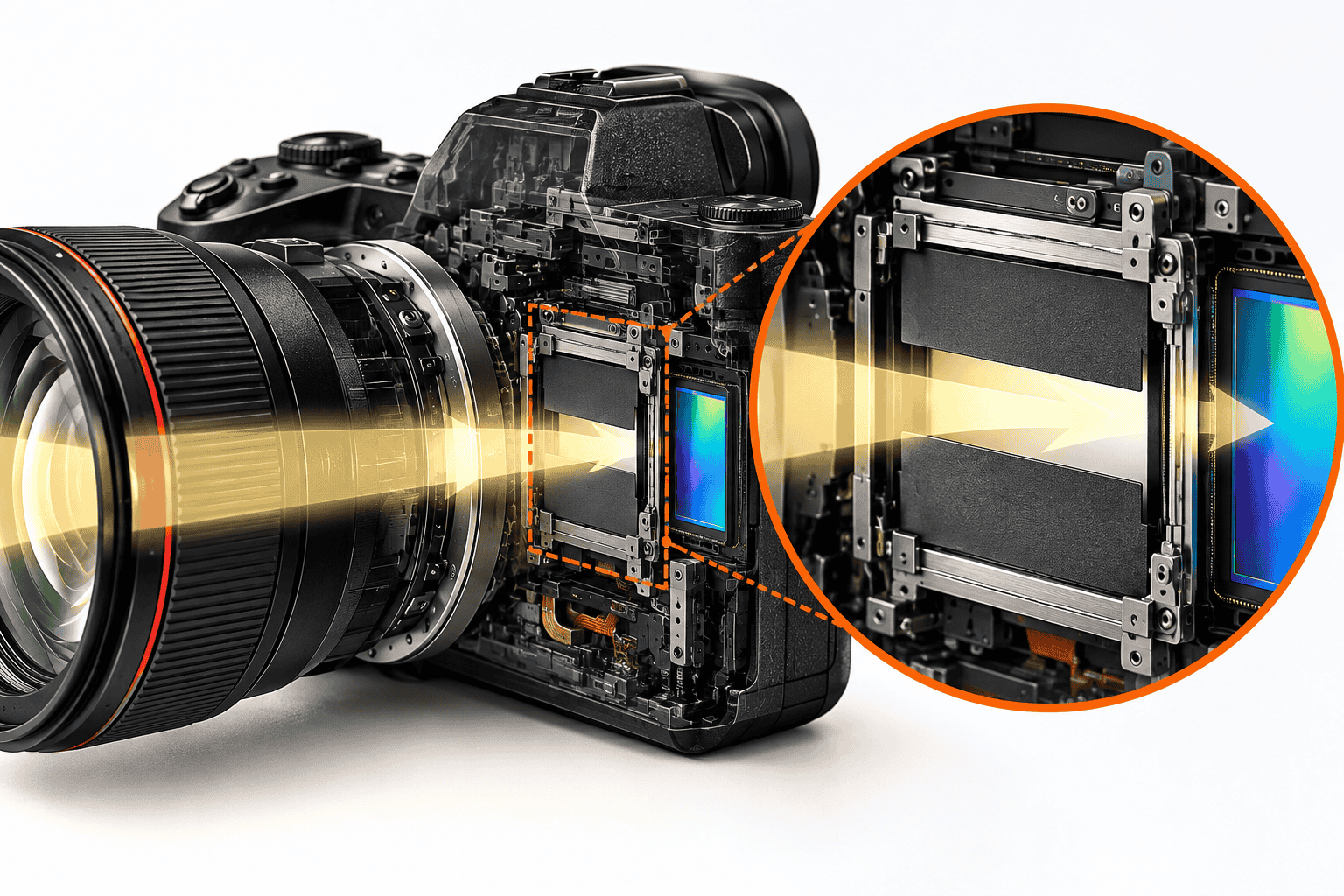
Mechanical, electronic first-curtain (EFCS) and electronic shutters all control how long the sensor receives light. Start with where the shutter sits, then follow what moves—and what is controlled electronically.
- Where is the shutter inside a mirrorless camera?
- “First” and “second” curtain describe timing, not depth
- What does a shutter actually do?
- Mechanical shutter: two curtains set the exposure
- Electronic first-curtain shutter: an electronic start
- Electronic shutter: sensor control at both ends
- Why can moving subjects look skewed?
- Compare the three modes: which should you choose?
- Frequently asked questions
- Bottom line
- Manufacturer sources
- Disclaimer
Where is the shutter inside a mirrorless camera?
In a mirrorless camera, light passes through the lens to the image sensor. On models with a mechanical shutter, its curtain unit sits just in front of the sensor. An electronic shutter does not add a physical “electronic curtain” there: the sensor controls exposure electronically.
“First” and “second” curtain describe timing, not depth
A mechanical shutter has a first curtain that starts exposure and a second curtain that ends it. “First” and “second” name the order in which they act—not which curtain is closer to the lens or sensor.
What does a shutter actually do?
A photo is made while the sensor receives light between a start time and an end time. This interval is the exposure time. The shutter modes differ in whether physical curtains or sensor electronics set those two times.
Mechanical shutter: two curtains set the exposure
At a relatively slow shutter speed, the first curtain opens fully, the whole sensor is exposed for a time, and then the second curtain closes. Dark gray below is a curtain; green is the area receiving light.
At a fast shutter speed, the second curtain starts before the first has finished opening. The gap between them travels across the sensor, so even at 1/4000 s the whole frame is not necessarily uncovered simultaneously for 1/4000 s.
Electronic first-curtain shutter: an electronic start
EFCS replaces the first curtain’s exposure-start function with electronic control at the sensor. A mechanical second curtain still ends exposure. The electronic start progresses across the frame to match the second curtain’s travel. It does not start exposure for every pixel at exactly the same instant.
EFCS reduces first-curtain movement, but the second curtain can still move and make sound. At a fast shutter speed with a wide-aperture lens near maximum aperture, it can alter the shape of out-of-focus highlights. If you notice this, compare with the fully mechanical mode.
Electronic shutter: sensor control at both ends
An electronic shutter does not run a mechanical curtain during capture: sensor electronics control the beginning and end of exposure. In a common rolling-shutter design, rows are processed at slightly different times. Electronic shutter does not automatically mean simultaneous capture of the whole frame.
For example, each row may be exposed for 1/2000 s while the time between recording the top and bottom rows is different from 1/2000 s. The amount varies by camera and shooting mode.
Why can moving subjects look skewed?
If a subject moves between the different times at which upper and lower rows are recorded, its position shifts within one photograph. This is rolling-shutter distortion.
How noticeable distortion is depends on the time needed to record the whole sensor and on subject or camera motion. Fast mechanical shutters also introduce a time difference as their curtains travel, but the effect depends on model and conditions. See our rolling-shutter distortion explainer for real-photo examples.
Compare the three modes: which should you choose?
With the mechanisms in mind, the following is a practical starting point. Available modes and speeds vary by camera, so check your model’s manual and make a test shot.
Swipe horizontally to read the comparison table.
| Feature | Mechanical | EFCS | Electronic |
|---|---|---|---|
| Exposure starts | Mechanical first curtain | Sensor electronics | Sensor electronics |
| Exposure ends | Mechanical second curtain | Mechanical second curtain | Sensor electronics |
| Sound / vibration | Curtains move | Less first-curtain movement | No curtain movement during capture; optional electronic sound varies |
| Rolling distortion | Traveling curtains create a time difference at fast speeds | Timing differs across the frame | May be prominent with a rolling sensor |
| Flicker / banding | Possible under flickering light | Possible under flickering light | Especially worth testing under flickering light |
| Fast bursts | Depends on the mechanism and model | Depends on the mechanism and model | Some models are faster, not all |
| Flash | Within sync-speed limit | Support and sync speed vary by model | Some models support it; others do not |
| Good for | Motion, flash, fast shots with wide-aperture lenses | Everyday photography, reduced curtain vibration | Quiet settings; high-speed bursts where supported |
- Everyday photos: If available, EFCS is a useful starting point.
- Action or flash: Start with mechanical; if using electronic, check distortion and flash compatibility.
- Quiet ceremonies: Consider electronic, but test for LED banding.
- Wide-aperture lens at high speed: If EFCS changes bokeh, compare with mechanical.
Frequently asked questions
Is an electronic shutter always silent?
It avoids the mechanical shutter’s operating sound, but an electronic sound setting or lens operation may still be audible.
Are stripes under LED lights a camera fault?
Not necessarily. A flickering light source can interact with the different capture times of sensor rows. Compare shutter speed, anti-flicker settings and shutter modes. Mechanical shutters can also show uneven brightness in some conditions.
Can I use flash with an electronic shutter?
It depends on the camera. Some models prohibit flash; others allow it with a sync-speed limit. Check the official specifications for both camera and flash.
Is an electronic shutter the same as a global shutter?
No. Many electronic shutters use rolling timing, with different rows recorded at different times. A global shutter is designed to align exposure timing across pixels and is used in certain models.
Bottom line
Mechanical uses first and second curtains; EFCS starts electronically and ends with a mechanical curtain; electronic controls both ends at the sensor. Try EFCS for everyday shots, mechanical for action or flash, and electronic for quiet situations where appropriate. If you see skew or stripes, switch modes and compare.
Manufacturer sources
- Sony: electronic first curtain and shutter location
- Nikon: first and second curtains and the high-speed slit
- Canon EOS R7: an example of mode-specific specifications
- Sony: electronic-shutter row timing and flicker
Disclaimer
This article describes common mirrorless-camera mechanisms using manufacturer information checked in September 2026. Curtain behavior, available modes, flash sync and anti-flicker features vary by model and settings. Consult the latest manual for your camera.

Comments